
A plastic pallet material that looks cheaper upfront can cost far more once it enters operation. Put an untested standard PP pallet into a freezer, or choose a low-priced “100% recycled” pallet without checking formulation and batch consistency, and forklift impacts, sustained loads, or cold handling may lead to cracks and deformation—not to mention product damage, downtime, and premature fleet replacement.
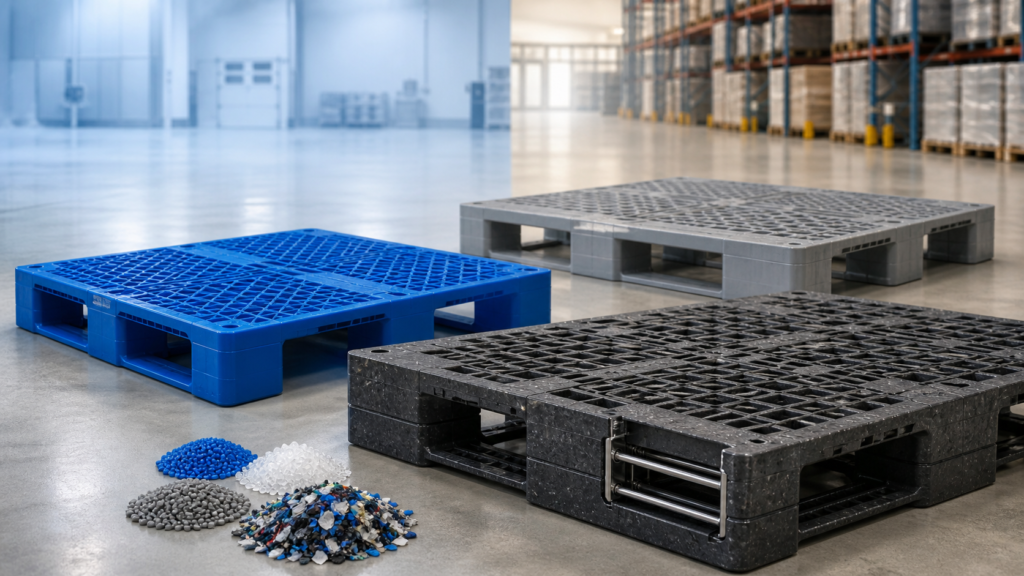
So, what are plastic pallets made of? Most are manufactured from HDPE, PP, LLDPE, recycled plastics, or composite materials, but no single material fits every application. This guide explains the differences between these plastic pallet materials, what additives and reinforcements do, and how to choose the right option for your load, temperature, and operating environment.
1. High-Density Polyethylene (HDPE)
HDPE is one of the most common materials used to make plastic pallets because it offers a practical balance of toughness, impact resistance, moisture resistance, and processing stability. Compared with the stiffer PP, an HDPE plastic pallet is generally more likely to flex and absorb energy during a forklift strike or drop instead of cracking immediately, which makes HDPE a common choice for frequently handled returnable pallets.
HDPE also tends to retain better impact performance at low temperatures. It does not absorb water and resists many common acids, alkalis, detergents, and industrial chemicals, making it suitable for cold chains, food and beverage logistics, warehouse circulation, wet environments, and closed-loop systems. For prolonged outdoor use, the formulation should include UV stabilization validated for the actual exposure conditions.

2. Polypropylene (PP)
The main advantages of PP are stiffness and heat resistance. Compared with standard HDPE, it generally bends less and can provide greater structural rigidity at a similar pallet weight, so PP plastic pallets are often considered for projects where dimensional consistency, automation interfaces, or long-term deflection are important.
PP’s higher heat tolerance can also suit selected warm production environments and cleaning processes. However, “heat-resistant” does not mean every PP pallet can withstand high-temperature steam or a continuous hot load; actual performance still depends on the PP grade, impact modification, pallet structure, load, and exposure time.
Low-temperature impact is the main risk to review. Standard PP can become more brittle than HDPE in cold conditions, so if the pallet will enter a freezer, travel outdoors in winter, or face frequent forklift impacts, confirm whether an impact-modified formulation is used and validate a production-intent sample at the real operating temperature rather than relying only on room-temperature material data.

3. Linear Low-Density Polyethylene (LLDPE)
LLDPE is not the default material for general-purpose pallets, but it has a clear role in selected rotationally molded, blow-molded, and polyethylene-blend designs. Its flexibility, impact absorption, and environmental stress-crack resistance suit hollow or thick-wall structures that must tolerate repeated deformation.
That flexibility also means an LLDPE plastic pallet is generally less rigid than an HDPE or PP pallet. For long-term stacking, open-beam racking, or applications with strict flatness requirements, toughness alone cannot prove suitability; wall-thickness distribution, internal structure, pallet weight, and support span all affect final deflection.

4. Recycled Plastics
“Recycled plastic” is not a single polymer. Recycled plastic pallets may contain recycled HDPE, recycled PP, recycled PE, post-industrial recycled material (PIR), post-consumer recycled material (PCR), clean in-house regrind, or a controlled PP/PE blend. Purity, processing history, and batch consistency can vary significantly between these sources.
Recycled resin can reduce virgin-material use and provide an attractive option for one-way export, general industrial transport, lightweight nestable pallets, and cost-sensitive projects. But a higher recycled percentage is not automatically the greener choice: if a pallet fails early, cannot be recovered, or needs frequent replacement, total material consumption may rise. A more useful comparison considers completed trips, damage rate, recovery route, and cost per cycle.
5. Composite Materials
Composite plastic pallets typically use HDPE, PP, or another plastic matrix combined with glass fiber, mineral filler, wood fiber, or another reinforcing material. These formulations can change stiffness, weight, shrinkage, and cost compared with a pure polymer. A small number of specialized pallets also use wood-plastic composites, although moisture behavior, hygiene suitability, and recycling options depend on the exact formulation.
Another design sometimes described as a “composite structure” uses separate steel bars inside the plastic pallet. The steel is not mixed into the resin, but it can directly support the deck or bottom runners and reduce deflection when the pallet spans open rack beams, which is why steel reinforcement appears in some rackable plastic pallets.
Greater reinforcement is not automatically better. Fibers and fillers can increase stiffness while changing impact behavior, pallet weight, and recyclability; steel bars add considerations around corrosion, cleaning, metal detection, and end-of-life disassembly. First identify whether the real problem is impact, long-term deflection, or rack span, then decide between formulation reinforcement and structural reinforcement.
What Additives And Reinforcements Are Used In Plastic Pallets?
A plastic pallet does not rely on base resin alone to meet every operating requirement. Plastic pallet manufacturers may use additives to manage sunlight, static electricity, slip, or fire performance, and may install anti-slip parts, RFID tags, or steel bars. The important question is not how many features a pallet has, but whether those features solve a real problem in your operating environment.
Color Masterbatch, UV Stabilizers, And Antioxidants
Color masterbatch changes pallet color and can help a business distinguish product lines, warehouse zones, or pallet uses. Black is common in recycled plastic pallets because it helps mask feedstock color variation, but color does not prove recycled content; virgin HDPE and PP can also use black masterbatch.
UV stabilizers slow fading, chalking, and performance loss caused by sunlight, while antioxidants help the material resist thermo-oxidative aging during molding and later use. These additives slow degradation rather than provide unlimited outdoor life, so a long-term outdoor project should still define sunlight exposure, climate, load, and expected service life.
Antistatic, Conductive, And Flame-Retardant Formulations
Antistatic and conductive formulations are mainly used for electronics, dusty processes, and other environments where static accumulation must be controlled. Do not approve a product from the label “ESD pallet” alone; define the required resistance range, test method, and whether humidity, wear, or washing can change performance.
Flame-retardant additives can change ignition and burning behavior, but a flame-retardant formulation does not make a plastic pallet fireproof. Where warehouse fire protection places restrictions on plastic pallets, review the specific model’s tested classification together with the formulation, idle-pallet stack height, commodity class, rack arrangement, and sprinkler system.
Fillers, Anti-Slip Parts, RFID, And Steel Reinforcement
Mineral fillers and fibers can adjust stiffness, shrinkage, weight, and cost, but excessive filler may reduce impact toughness or complicate recycling. Judge whether the filler level is suitable from pallet weight, visual consistency, and actual load performance rather than treating “reinforced material” as an automatic sign of higher quality.
Anti-slip plugs and strips are usually made from rubber or elastomers to reduce movement between the load, fork tines, pallet, or floor. RFID components record pallet identity and circulation data. These are fitted components rather than additives mixed into the base resin, so they need separate consideration during cleaning, maintenance, and recycling.
Internal steel bars are mainly used to control long-term deflection on open-beam racks. More bars do not necessarily produce a better pallet because they also increase weight, cost, and recycling steps; their location must match the rack support direction, load distribution, and pallet structure.
Why Material Formulation Changes Need Approval
The same HDPE, PP, or recycled-material label does not guarantee an identical formulation. A change in resin source, regrind percentage, filler, or masterbatch can affect melt flow, molding integrity, low-temperature impact, color, and long-term deflection, so the material route used for an approved sample should remain consistent in bulk production.
Before approving the order, record the base resin, acceptable virgin or recycled range, key functional additives, color, and reinforcement method in the agreed specification. If any of these items need to change later, review the change and its possible effects before deciding whether a new sample or repeat validation is required—otherwise the model number may stay the same while its real-world performance changes.
What Should You Consider When Choosing Plastic Pallet Materials?
When choosing a plastic pallet material, the first question should not be “HDPE or PP?” It should be “Where and how will this pallet work?” Temperature, load support, impact frequency, cleaning method, and expected cycles determine the properties you need; without this operating context, even a detailed resin name cannot support a reliable decision.
| Operating Condition | Recommended Material Starting Point | What To Confirm Before Purchase |
| Freezers, winter transport, or frequent forklift impacts | HDPE or impact-modified PE validated at low temperature | Minimum operating temperature, cold-condition sample test, actual load, and impact risk |
| Higher temperatures, hot-water washing, or greater stiffness requirements | PP or a suitable modified PP | Actual temperature, exposure time, load duration, and allowable deflection |
| Rotational molding, blow molding, or a flexible hollow structure | LLDPE or a controlled PE blend | Material ratio, wall-thickness distribution, long-term deformation, and finished-pallet load tests |
| One-way export or cost-sensitive projects | Controlled recycled HDPE, PP, PE, or a compatible blend | Polymer source, PIR/PCR percentage, odor, color, contamination, and batch consistency |
| Open-beam racking or long-term heavy loads | HDPE, PP, a composite formulation, or steel reinforcement designed for the required stiffness | Beam span, support direction, load distribution, temperature, storage time, and racking test conditions |
| Food, beverage, pharmaceutical, or clean applications | Controlled, traceable material with the required documentation | Direct contact with unpackaged product, additives, surface design, cleaning method, and applicable documentation |
| Long-term outdoor use | UV-stabilized HDPE, PP, or another formulation validated for the environment | Climate, sunlight, load, exposure duration, and expected service life |
| ESD- or fire-sensitive environments | Validated antistatic, conductive, or flame-retardant formulation | Resistance range, fire classification, test conditions, and actual warehouse requirements |
Material is only one part of a complete pallet design. Even with the same resin, deck thickness, rib layout, base structure, steel reinforcement, and molding consistency can change static, dynamic, and racking performance. Final approval should therefore apply to the exact pallet model under the real support conditions—not treat raw-material data as proof of pallet load capacity.
Plastic Pallet Material FAQs
What Is The Difference Between HDPE And LLDPE Plastic Pallets?
HDPE is generally more rigid and is widely used for injection-molded returnable pallets, while LLDPE is more flexible and appears in selected rotationally molded, blow-molded, or PE-blend structures. If your application involves sustained loads or open-beam racking, compare the exact pallet structure and deflection test rather than material toughness alone.
Should You Choose Virgin Or Recycled Plastic Pallets?
Virgin resin is often a more direct starting point when traceability, strict hygiene documentation, or batch consistency matters, while controlled recycled material may suit projects focused on cost and reduced virgin-resin use. Make the final choice from actual load, temperature, expected trips, and finished-pallet testing rather than treating either material route as universally better.
Is Fiber Reinforcement Better Than Steel Reinforcement?
Fiber reinforcement changes the stiffness and impact behavior of the complete plastic matrix, while steel bars control deflection at specific areas of the deck or runners. The better option depends on your rack span, load duration, cleaning requirements, corrosion risk, pallet weight, and recycling route.
Which Plastic Pallet Material Is Better For Outdoor Use?
UV-stabilized HDPE is often a practical starting point where moisture, low temperature, and frequent impact matter, although properly stabilized PP or another formulation may also work. Share the local climate, sunlight exposure, load, and target service life before choosing an outdoor plastic pallet material.
Are Standard Plastic Pallets Flame-Retardant?
Standard HDPE, PP, and recycled plastic pallets should not be assumed to be flame-retardant. If fire performance matters, confirm the exact flame-retardant formulation and test classification, then check it against the warehouse requirements for commodity class, storage arrangement, and sprinkler protection.
Final Thoughts
Choosing the right plastic pallet material is not about finding one “universal” polymer. It is about matching material performance to the actual load, temperature, support condition, and reuse target. HDPE suits many cold and impact-intensive applications, PP emphasizes stiffness and heat resistance, and LLDPE serves selected flexible hollow structures; recycled and reinforced formulations can support one-way logistics, cost control, or rack performance when properly specified.
Since 2000, ENL Plastic has developed more than 700 injection molds and over 600 existing pallet models, supported by 60 production lines and a long-term inventory of more than 300,000 pallets. Depending on the project, we can provide virgin-material, recycled-material, and reinforced pallet solutions. For suitable models under normal operating conditions, virgin-material pallets can cover a working range from −40°C to 70°C, with a reference service life of 7–10 years or around 200 cycles.
Share your required pallet size, load, floor or rack support, operating temperature, and annual volume, and ENL Plastic can match an existing model or develop a custom solution. Production follows an ISO 9001 quality management system, dimensional tolerance is controlled within ±2 mm, and products carry a three-year warranty. Samples are normally dispatched within one week, while full-container orders can be scheduled for shipment within 7–15 days after a 50% deposit.